Self-Supervised Learning to Unveil Brain Dysfunctional Signatures in Brain Disorders: Methods and Applications
Abstract
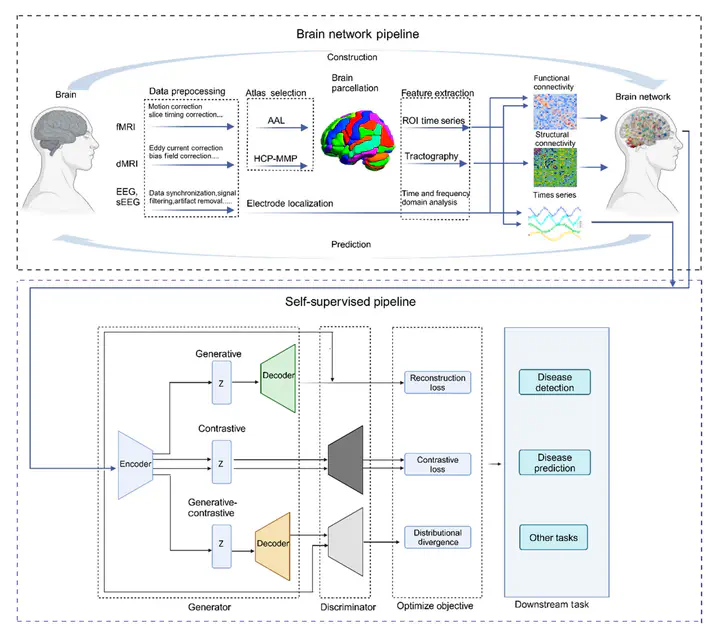
Precisely decoding brain dysfunction from high-dimensional functional recordings is crucial for advancing our understanding of brain dysfunction in brain disorders. Self-supervised learning (SSL) models offer a transformative approach for mapping dependencies in functional neuroimaging data. Leveraging the intrinsic organization of brain signals for comprehensive feature extraction, these models enable the analysis of critical neurofunctional features within a clinically relevant framework, overcoming challenges related to data heterogeneity and the scarcity of labeled data. This paper provides a comprehensive overview of SSL techniques applied to functional neuroimaging data, such as functional magnetic resonance imaging and electroencephalography, with a specific focus on their applications in various neuropsychiatric disorders. We discuss 3 main categories of SSL methods, including contrastive learning, generative learning, and generative-contrastive methods, outlining their basic principles and representative methods. Critically, we highlight the potential of SSL in addressing data scarcity, multimodal integration, and dynamic network modeling for disease detection and prediction. We showcase successful applications of these techniques in understanding and classifying conditions such as Alzheimer’s disease, Parkinson’s disease, and epilepsy, demonstrating their potential in downstream neuropsychological applications. SSL models provide a scalable and effective methodology for individual detection and prediction in brain disorders. Despite current limitations in interpretability and data heterogeneity, the potential of SSL for future clinical applications, particularly in the areas of transdiagnostic psychosis subtyping and decoding task-based brain functional recordings, is substantial.

Chenfei Ye
Research Associate Professor
The brain’s billions of neurons resemble trees of many species and come in many fantastic shapes. Only the most determined explorers can hope to capture a glimpse of this forest’s interior, and even they see little, and see it poorly.